
National 6G Testbed
What is the National 6G Testbed?
The National 6G Testbed gives Dutch companies, start-ups and technology partners a head start on the future. 6G is expected to become available through national network providers around 2030. Organisations that start developing new products and services today will gain a clear advantage. The 6G Testbed offers a unique opportunity to carry out extensive testing on a private network, enabling organisations to prepare for the next generation of wireless technology.
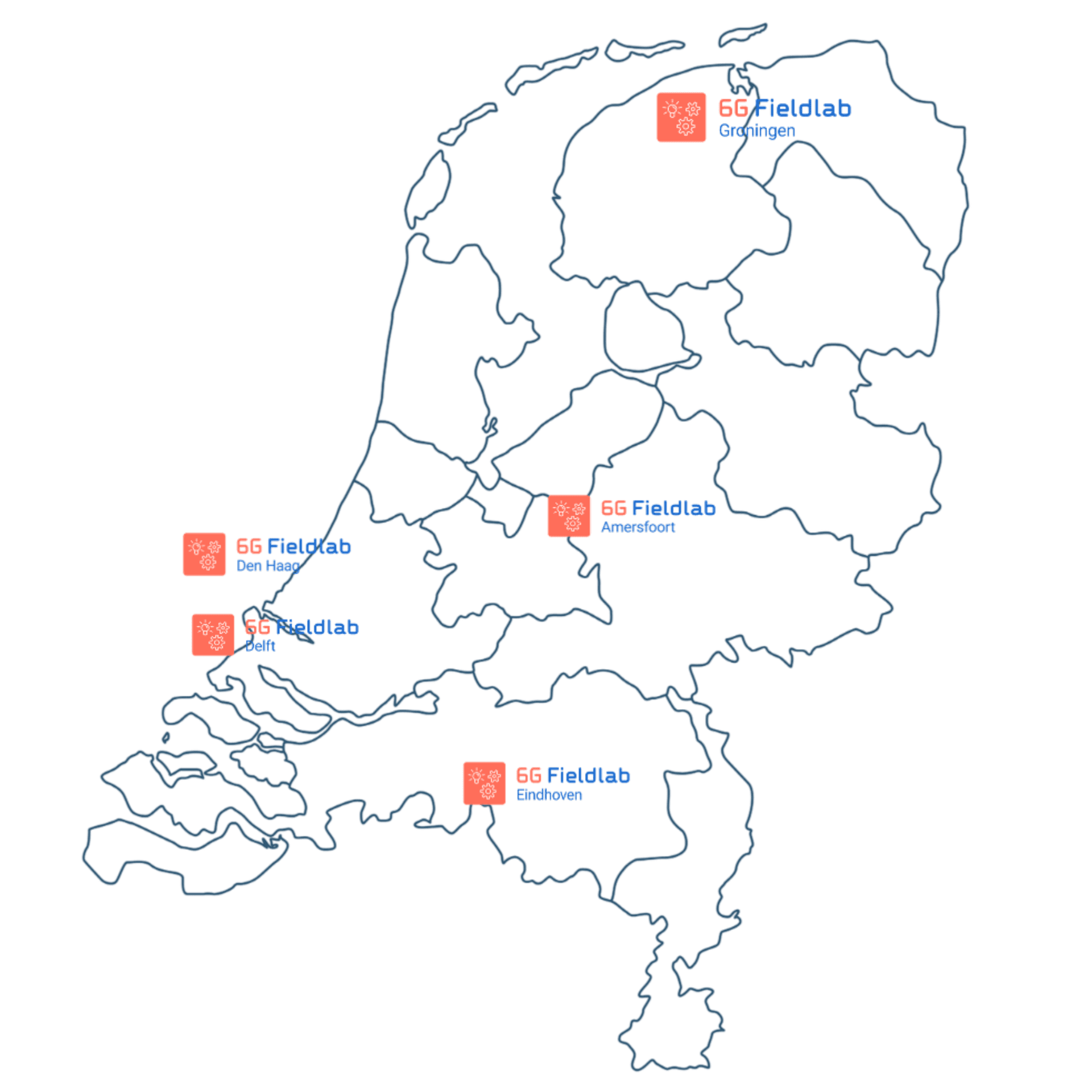
The National 6G Testbed is a collaboration between technical universities, research institutes and leading companies in The Netherlands. Together, these 60 partners offer companies the opportunity to test the latest releases of current 5G technology in realistic fieldlab environments. In practice, this means that companies can access five locations across The Netherlands to make their products or services 6G-ready. High-tech experts are available to professionally support the development, testing and validation process. This collaboration between industry and knowledge institutions within the fieldlabs is supported by government funding.

Why was the 6G Testbed established?
Mobile networks are a key driver of the digitalisation of our society. They contribute to economic growth and competitiveness across all sectors. Through innovation and collaboration between industry, knowledge institutions and government, The Netherlands is building a strong position in the global 6G-value chain. The Future Network Services program aims to establish an international leading position for The Netherlands in 6G. This strengthens the Dutch economy and supports sustainable long-term growth.
6G and AI
With 5G, many new data-intensive applications have already become possible. Compared to 4G, 5G offers extremely low latency, ultra-fast data processing and a high level of data security. This enables advanced VR and AR applications and wireless solutions that cannot be reliably supported by Wi-Fi. Examples include robotics in greenhouse horticulture, sensor technology for smart energy management, and new applications in mobility and logistics. 6G will go even further, especially in combination with artificial intelligence. Think of support during complex medical procedures, maintenance of offshore wind turbines, smarter traffic intersections and robots that harvest fruit.

This is what 6G will enable

Where can you experiment?
The current and most recent technology is known as Beyond 5G. This is an intermediate step on the road towards fully developed 6G technology. You can experiment at the following fieldlabs across The Netherlands:
- 6G Fieldlab Delft – Do IoT Fieldlab
- 6G Fieldlab Groningen – ICCS
- 6G Fieldlab The Hague – TNO
- 6G Fieldlab Amersfoort – RDI
- 6G Fieldlab Eindhoven – BDF
Use cases
From autonomous drones to remote operations, 6G can enable new applications that require reliable, low-latency and widely available connectivity. These are a few examples we are currently working on:
- Edge computing and AI
With partner Oakestra, we are exploring how mobile users can access local edge computing resources that move with them as they travel. This reduces latency and keeps computing close to the user while helping to keep sensitive data secure. - Drone communication
At Unmanned Valley, we are working with TU Delft on an open-source outdoor Beyond 5G setup for drone testing. We are also exploring Beyond Visual Line of Sight (BVLOS) operations, enabling drones to operate over greater distances. The flight corridor from Unmanned Valley towards the North Sea can create opportunities to test longer-range communication as well. - Localisation
Accurate localisation is key to applications for sectors such as Industry and Horticulture, where knowing the precise position of people, equipment or objects can make a real difference. At Unmanned Valley, we are exploring Integrated Sensing and Communication (ISAC) and Joint Communication and Sensing (JCAS) using our outdoor Beyond 5G setup. - Offshore communication
Offshore environments present unique challenges for wireless communication. We are working with multiple partners to understand how factors such as distance, the physical environment and changing weather conditions affect connectivity offshore. - Non-Terrestrial Networks
Non-Terrestrial Networks (NTN) can extend wireless connectivity beyond the reach of traditional terrestrial networks. We are exploring how satellite communication can complement terrestrial networks and provide connectivity in remote or hard-to-reach locations. This opens up opportunities for applications such as offshore operations and remote monitoring. - Teleoperation
Teleoperation enables people to control machines and systems remotely, making reliable, low-latency communication essential. We have expertise in testing teleoperation applications where Beyond 5G performance can make a difference. It could also, when combined with Non-Terrestrial Networks, enable people to remotely control and maintain equipment on ships, offshore platforms or wind turbines. Even where terrestrial connectivity is limited.
More information about 6G
For more information about this wireless technology, visit the website of Future Network Services and TNO.
Let's innovate together!
Ask your question. You provide the ideas, we provide the connection – both human and wireless.
TU Delft
Molengraaffsingel 29, 1st floor
2629 JD Delft

