The ‘Internet of Things’ (IoT), in which large numbers of devices exchange information via wireless connections, demands super-fast connections with high reliability and short response times. 5G, the new generation of mobile communication networks, offers this possibility. “Self-driving cars in a busy street must be able to communicate very quickly with their surroundings,” said Schmitz. “You need 5G for that.”
TU Delft
Several faculties – EEMCS, Technology, Policy and Management (TPM) and Industrial Design Engineering (IDE) – work together within TU Delft to solve not only the technical challenges, but also address issues related to governance, design and social aspects.
Remote surgery
5G is also a condition for the so-called tactile internet, meant to convey the sense of touch via the internet. With tactile internet, a surgeon can remotely perform an operation with a robotic arm, explained Fernando Kuipers – associate professor of the EEMCS faculty and one of the initiators of the Do IoT field lab – during the crowded event.
“A requirement is that the robot arm responds extremely quickly and that the surgeon must also be able to ‘feel’ that he is not cutting too deeply, for example. That is only possible with the very short response time of the 5G network. ”
Comprehensive solution
The new field lab offers the possibilities to try out all these applications, so that it quickly becomes clear which innovations work and which do not. “We cannot do this alone, and that is why we have a number of partners to work together on a comprehensive solution,” says Schmitz. The Do IoT Fieldlab was founded by the province of South Holland, TNO, the municipality of Delft, Metropolitan Region of Rotterdam The Hague (MRDH), municipality of Katwijk, Holland Rijnland and TU Delft.
Boost for South Holland
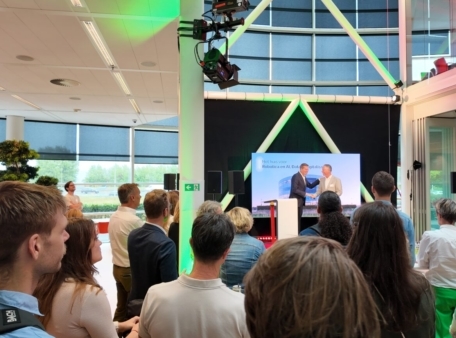
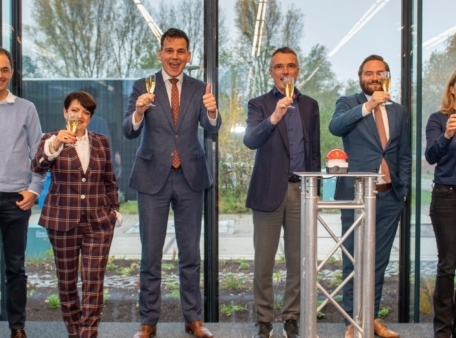
During the meeting on the TU Delft Campus, alderman Saskia Bruines of the municipality of The Hague performed the opening act on behalf of the MRDH: a demonstration of the tactile internet. The MRDH invests 200,000 euros in the Do IoT Fieldlab. “This new technology offers many opportunities for the region,” said Bruines. “It will give the economy and the province a nice boost.”
Unmanned Valley Valkenburg
The new lab has test locations on the TU Delft Campus (The Green Village) and Unmanned Valley Valkenburg near Katwijk. Drone applications will be tested at Unmanned Valley Valkenburg, alderman Gerard Mostert said. “At sea, for example, you can let drones communicate via 5G in order to detect drowning people faster, for example.”
T-Mobile
Ook T-Mobile is betrokken bij het Do IoT Fieldlab. Het telecombedrijf is vooral geïnteresseerd in de problemen die worden opgelost. “Wij moeten het 5G-netwerk gaan bouwen. Dat kunnen we alleen als we weten waarvoor het gaat worden gebruikt”, zei Egbert Kroon. “Maar het leuke van het Internet of Things is: de wereld is onbeperkt. We kunnen elk probleem oplossen.”
The Green Village and railway station Delft Campus
The Green Village is the test location in Delft. Self-driving cars can tested there; the event featured an interesting demo. But 5G and IoT applications will also be tested around the new Delft Campus station. “Here stands a very proud alderman,” said Bas Vollebregt on behalf of the municipality. He pointed to the countless other field labs at the TU Delft Campus, including RoboHouse, RADD and RAS. “They will also explore the possibilities of this new communication technology in collaboration with the Do IoT Fieldlab.”
Living lab Scheveningen
The Do IoT Fieldlab also makes the connection with other living labs in Scheveningen and Rotterdam, where, among other things, is tested how a new smart digital infrastructure can be used for crowd control. “The great thing is that everyone complements each other and every municipality takes the role in which it is strong,” said Vollebregt. Bruines: “We can learn a lot from each other.”
Enthusiasm
“It is very nice to see that so many people are enthusiastic about working with us. Stimulating cooperation between governments, knowledge institutions and the business community is an important part of the field lab,” said programme manager Lenneke de Voogd of TU Delft. “We are going to build a great programme for that together.”
Cybersecurity