Energy-efficient systems for 6G
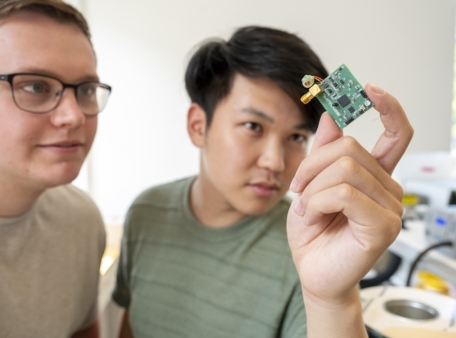
The IoT-ZERO project is working on the answer. Within the projects, technology is developed for battery-free and energy-harvesting IoT systems that consume extremely low amounts of power and can derive energy from their surroundings. This enables devices to operate autonomously for long periods with minimal maintenance. The goal: to develop devices that do not require an external power source. In this way, IoT-ZERO contributes to a more energy-efficient IoT system and the sustainable development of future 6G networks.
Energy-neutral system
Researchers and faculty members Arash Asadi and Przemyslaw Pawelczak, from the TU Delft Faculty of Electrical Engineering, Mathematics and Computer Science, are working on new sensors, communication technologies, and network architectures to create energy-neutral IoT systems for future 6G networks in Europe. The project is coordinated by the Vienna University of Technology (TU Wien) and brings together ten partners from eight European countries.
IoT-ZERO investigates how future 6G networks can be designed sustainably for a world with billions of connected devices. 5G already enables large-scale connectivity for applications such as smart factories, autonomous systems, and industrial IoT solutions. With 6G, not only will the number of connected devices increase further, but so will the need for energy-efficient technology. From smart sensors in industry and logistics to applications in energy and infrastructure, an increasing number of devices are continuously collecting, processing, and sharing data with one another.
Partners
Do IoT Fieldlab supports the project in various experiments by making suitable, realistic test environments available, such as SAM XL for industry related cases and Unmanned Valley for unmanned vehicles.
The project is coordinated by the Technische Universität Wien and brings together ten partners from eight European countries. Other academic partners include TU Delft, IMDEA Networks, and the Slovak University of Technology in Bratislava. In addition, various industrial and technology companies are participating, including Thales (France), Qascom (Italy), Lasting Software (Romania), Sensoneo (Slovakia), and Latvijas Mobilais Telefons (Latvia).
Together, they contribute expertise in the fields of 6G, IoT, cybersecurity, software, and telecom applications. In this way, IoT-ZERO helps move Europe forward with sustainable, scalable, and future-proof IoT solutions.
Funding
The consortium project receives funding through the EU HORIZON Joint Undertaking Research and Innovation Actions call for Advanced IoT and Device Technologies.