Making the electricity grid smarter in real time, while keeping critical communications running during a blackout? Together with Future Network Services, TNO, TU Delft, and Nokia, we’re testing exactly that with the new 600 MHz antenna.
The Netherlands is taking a major step toward the next generation of mobile networks. The Future Network Services (FNS) program, led by TNO, is putting a 600 MHz test mast into operation on the TU Delft campus. The antenna is one of the first in Europe to use the latest technology (5G-Advanced Release 18), from which 6G will evolve.
The antenna is now live at TU Delft Campus and lays the groundwork for 6G. Using “5G-Advanced Release 18”, it provides highly reliable coverage over long distances and through obstacles. Covering several hundred square kilometres as part of the National 6G Testbed, it gives Do IoT Fieldlab and other partners (such as Integer Technologies, Comforest, AIMZ, and Cellnex Telecom) the opportunity to test tomorrow’s connectivity today.
The arrival of 6G will bring an even greater number of connected devices. But there’s a challenge we can’t ignore: how do we scale the IoT without sending energy consumption through the roof?
Recently, Do IoT Fieldlab installed a Beyond 5G network at SAM XL, making it one of the test facilities within the National 6G Testbed. Since then, new experiments have become possible. Experiments that simply weren’t possible before.
Solutions for challenges such as grid congestion? They might be closer than you’d expect. Imagine a building that knows what is happening indoors and adjusts its energy use accordingly. By combining insights into occupancy, energy consumption, and indoor climate, smart buildings can reduce peak loads and use energy more efficiently. This makes buildings not only more sustainable, but also safer and more efficient.
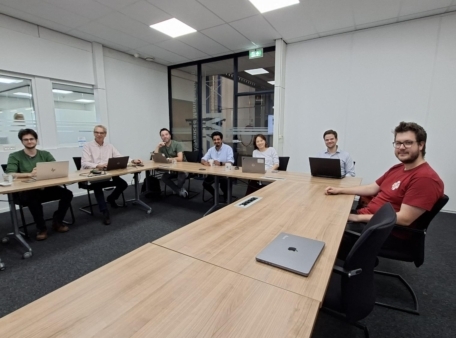
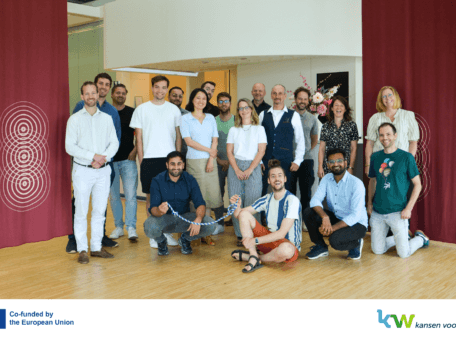
Recently we were pleased to initiate the official kick-off of Project WoW, bringing together an ambitious consortium of partners including TU Delft, Do IoT Fieldlab, RoboHouse, TNO, SenseGlove, Mondai | House of AI, Highlight Delft, Perciv AI, Pythia Energy Intelligence, Comforest, EduvolutionX, BrainBite, and RadioSense.