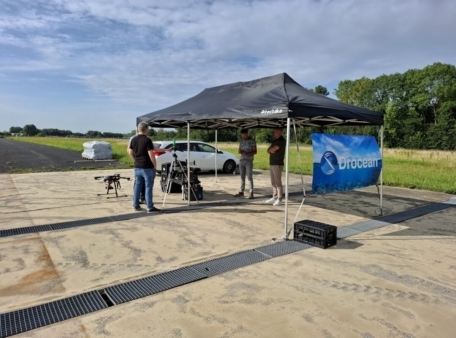
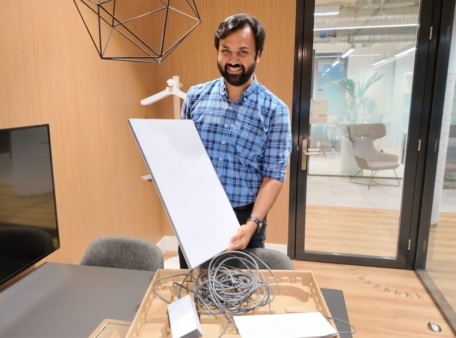
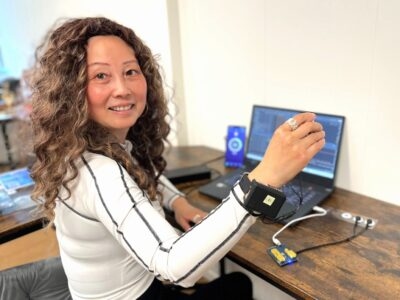
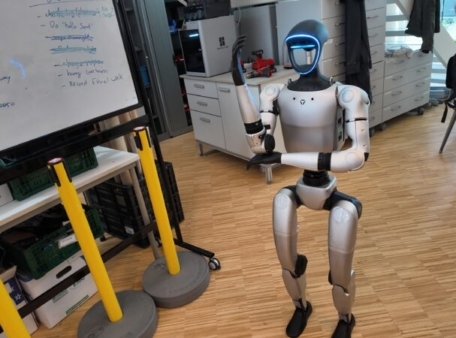
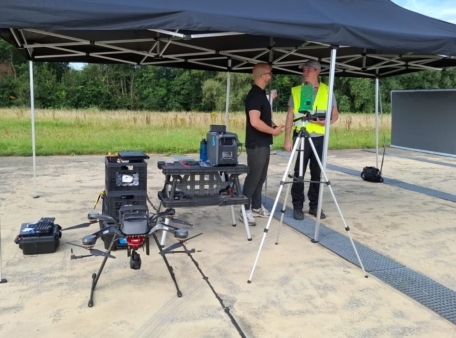
Together with Do IoT Fieldlab, ExRobotics embarked on the high-tech exploration, using our 5G testing facilities on TU Delft Campus. According to Iwan de Waard, director of ExRobotics, it is essential to invest in new technology. “Few SMEs are likely to have an entire team of engineers or an entrance to the Dutch research institute TNO for expert advice. Through the field lab you get access to all kinds of knowledge and expertise, as well as an environment where you can perform tests. I particularly like the tailor-made approach: you can specify exactly what you want to test and the team contributes ideas. It is a great pleasure to pioneer with 5G technology. For example, what is the relationship between the shape of the antenna and your connectivity and upload and download speed? Within the field lab we have the opportunity to try out new features and measure them effectively.”
The robot can detect hazardous gases and creates an image of the environment, which is stored in a digital twin. This requires enormous capacity in terms of image processing and data exchange. With current robots that operate with 4G, the images are stored temporarily and transferred once in a while to an employee of an oil platform, for example. It would be hugely beneficial to achieve this greatly faster with 5G. Part of the research focused on determining exactly what speed can actually be achieved. Large industrial companies would benefit from immediately knowing where a leak is located and how much risk it might cause. The faster they can make this assessment, the better they can act accordingly.
Heat
The research included tests with edge computing: processing data locally instead of in the cloud. Iwan: “If a sensor generates so much data that it cannot be processed via 4G, we now understand how to solve this via a private 5G network. In other words, I can resolve the slightest latency. And that, of course, is essential when using our robot.” In addition to testing data transmission, there are also practical challenges in meeting stringent safety requirements. For example, the heat produced by a modem, Iwan explains. “Normally you would incorporate a fan so that equipment doesn’t get overheated. In an explosive environment with hazardous gases, this is not an option. So we are limited in terms of what we can do. Then, how do we cool the modem? The experts also think along with us in that respect.”
Pascal Heijnen, Senior Consultant 5G and IoT at TNO, explains what his focus was in this research. “We tested the robot at Do IoT Fieldlab with a built-in 5G modem and SIM card. This would not work in foreign countries at the moment. With a SIM card from a Dutch telecom provider you can get a connection via roaming, but the data traffic is always processed through your home country. As a result, you cannot use the benefits of a 5G network, such as the high bandwidth and low latency.”